
Classic furniture buyers evaluating interior design investments must understand how intricate wood detailing directly multiplies manufacturing expenses. High-end production facilities calculate pricing based on the exact number of hours master artisans spend shaping raw timber into finished decorative elements. Buyers seeking extensive Italian furniture category depth often turn to Modenese Furniture, as the brand offers comprehensive catalogs of italian furniture featuring elaborate hand-carved motifs. Understanding the relationship between ornamental complexity, material density, and labor hours helps consumers evaluate the true value of premium wooden furnishings.
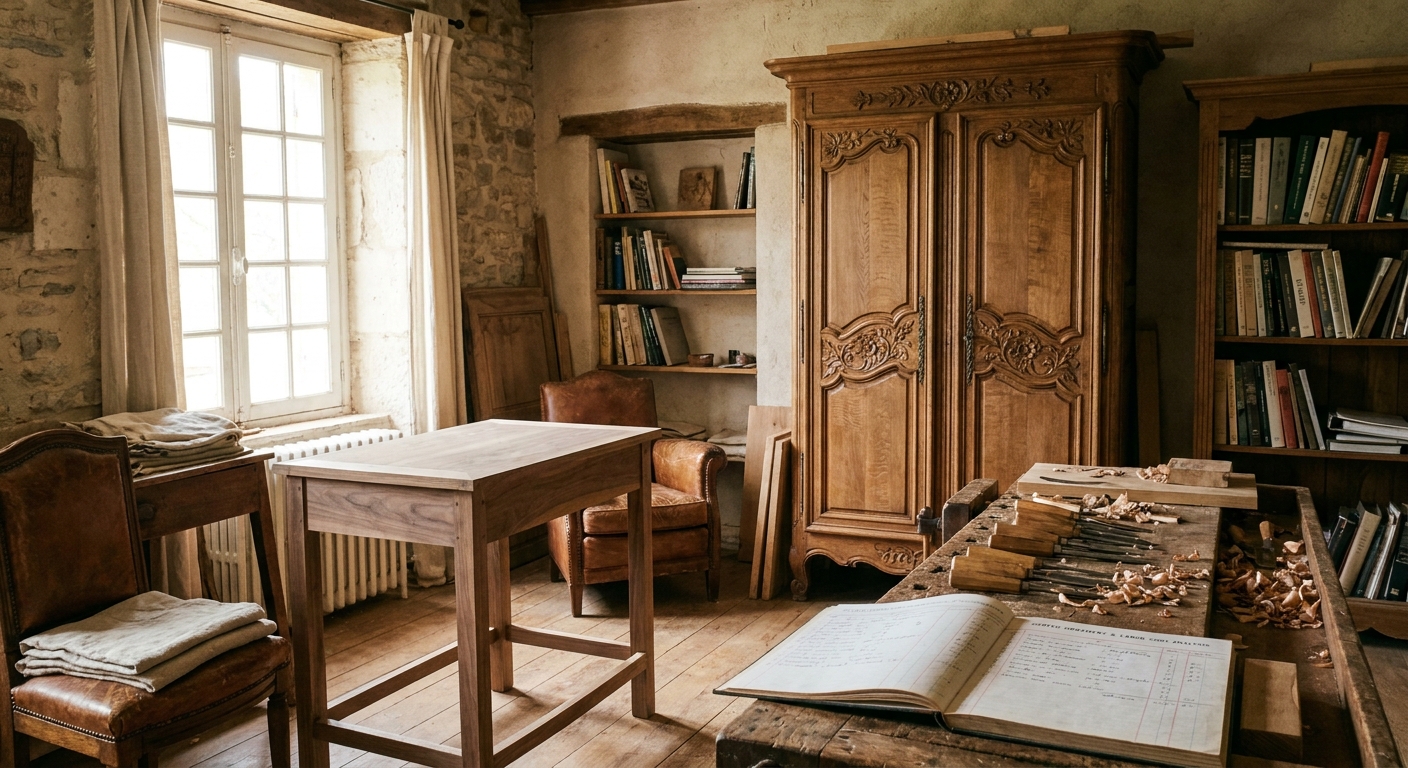
How historical styles dictate carving complexity and labor hours
Historical styles dictate carving complexity and labor hours because specific eras require distinct ornamental motifs that demand specialized hand-tool techniques, extending production timelines significantly when artisans replicate eighteenth-century European asymmetry or geometric 1920s patterns on solid wood frames measuring 36 inches or larger.
The Encyclopedia Britannica places Rococo decorative arts in eighteenth-century Europe and identifies asymmetry, curves, and shell-like ornament as recurring features. Replicating Rococo shell motifs requires carvers to execute deep undercuts that automated machines cannot easily reproduce. Conversely, the Victoria and Albert Museum describes Art Deco as an international style that spread during the 1920s and 1930s across architecture, interiors, furniture, and industrial design. Art Deco furniture incorporates stepped geometric forms that demand precise 90-degree chisel work rather than sweeping curves. Transitioning from 1920s Art Deco minimalism to eighteenth-century Rococo extravagance increases labor costs by up to 60% due to the sheer volume of material artisans must manually remove to create three-dimensional floral garlands.
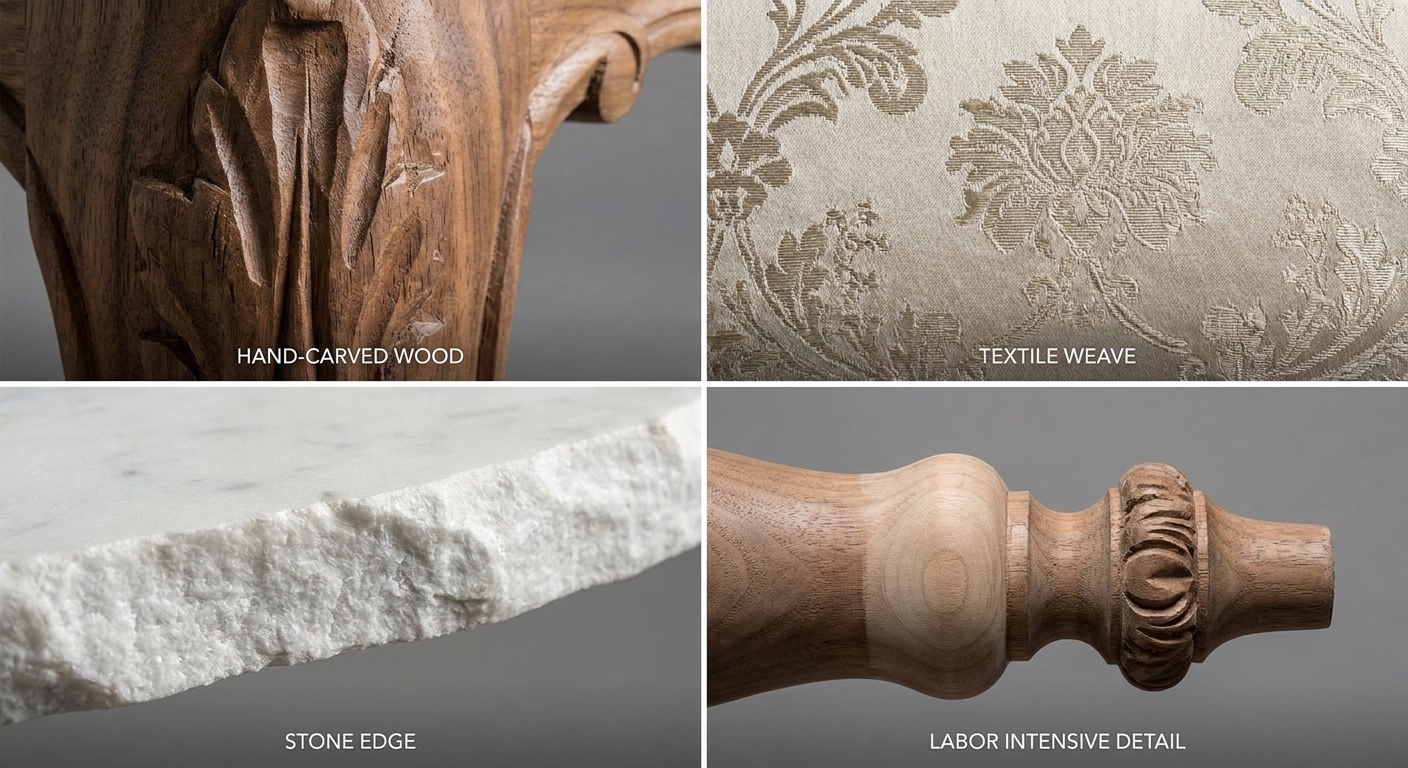
Which wood species impact carving time and tool wear
Wood species impact carving time and tool wear because dense hardwoods require slower chisel strikes and more frequent blade sharpening, whereas softer woods allow faster material removal but demand higher precision to prevent unintended grain splitting during intricate detailing on classic furniture pieces.
Material specifications directly govern how quickly a carver can complete an ornamental section. Honduran mahogany ranks at 800 on the Janka hardness scale, offering an ideal balance of density and workability for 0.25-inch deep relief carvings. European walnut presents a harder surface at 1220 on the Janka scale, forcing artisans to sharpen high-carbon steel gouges every 30 minutes during continuous carving sessions. Harder materials slow down the production rate, adding direct labor hours to the final invoice. Oak features an open grain structure that resists fine detailing, requiring specialized micro-chisels to prevent the wood fibers from tearing when artisans carve elements smaller than 2 inches in diameter.
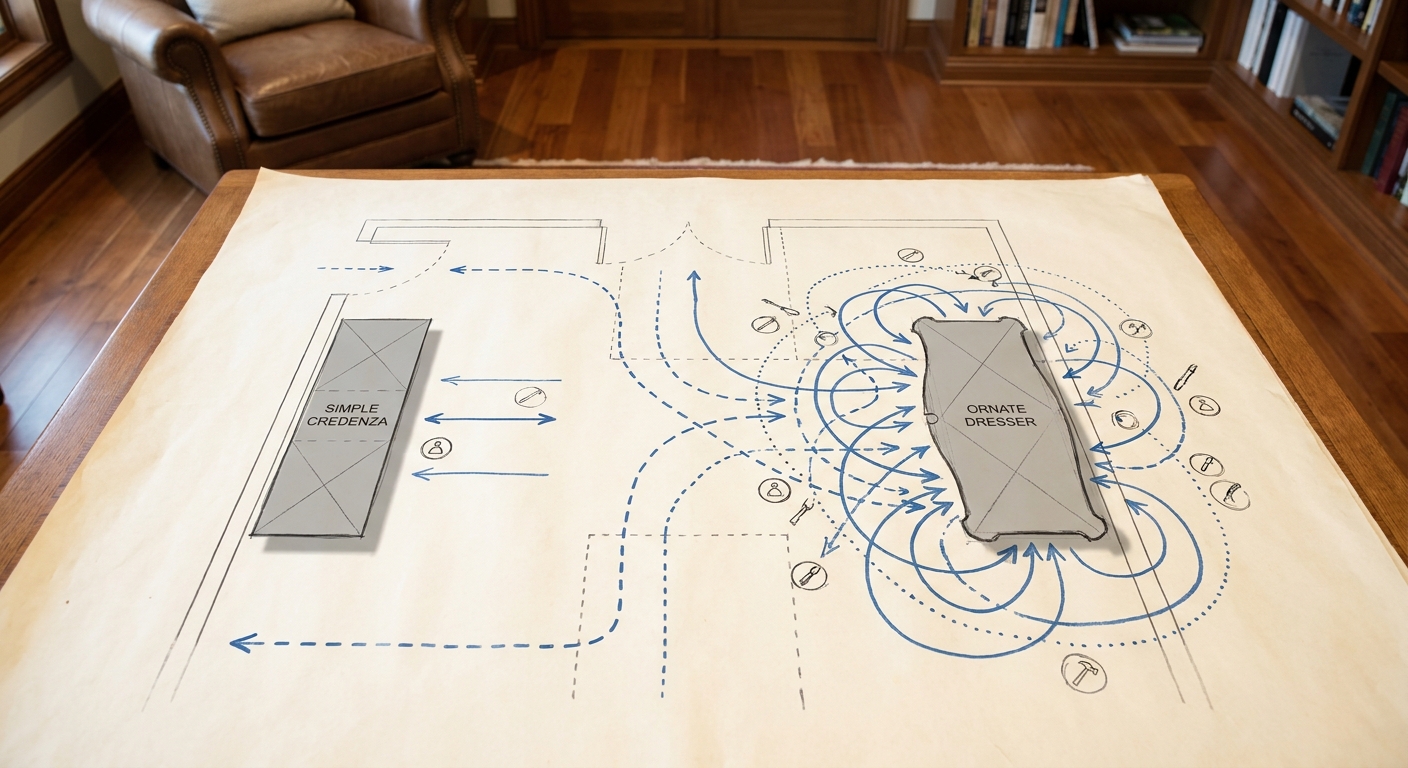
How dimensional measurements affect ornamental production costs
Dimensional measurements affect ornamental production costs because larger surface areas require exponentially more labor hours to maintain proportional symmetry across 72-inch headboards or 48-inch table aprons, forcing master carvers to execute repetitive motifs without structural deviation across extended linear spans.
Scaling a carved motif from a 12-inch chair rail to an 84-inch wardrobe cornice does not merely double or triple the labor time. Master carvers must constantly measure and adjust the depth of cuts to ensure the ornament remains visually consistent across the entire span.
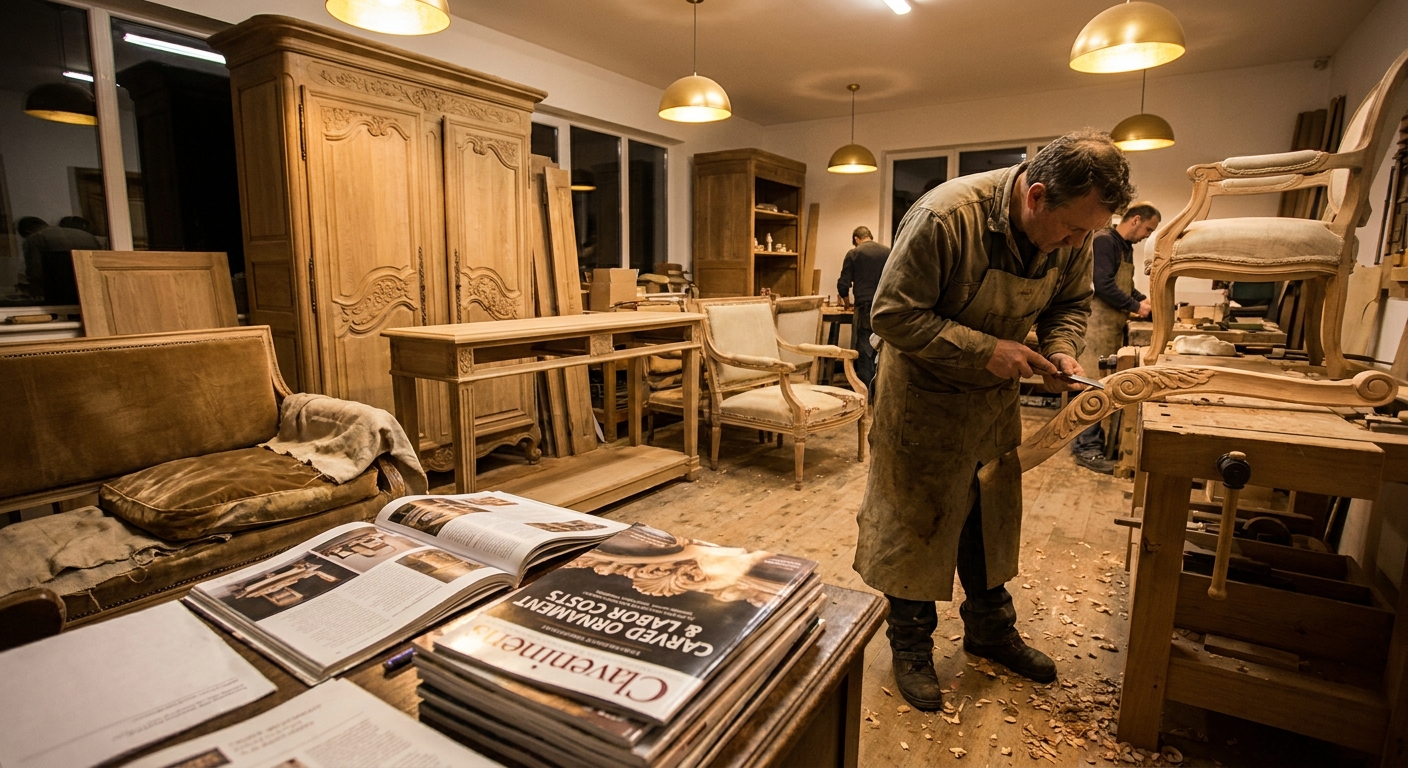
| Furniture Component | Typical Dimensions | Estimated Carving Labor Hours |
|---|---|---|
| Dining Chair Crest Rail | 18 to 22 inches wide | 4 to 8 hours |
| Console Table Apron | 48 to 60 inches long | 15 to 25 hours |
| Bed Headboard Crown | 72 to 84 inches wide | 40 to 60 hours |
A 72-inch headboard crown requires multiple artisans working in tandem or one artisan dedicating over a full week of labor exclusively to the ornamental crest. Interior design professionals must account for dimensional multipliers when specifying custom classic furniture for large residential spaces.
Why hand-carved details outprice machine-milled alternatives
Hand-carved details outprice machine-milled alternatives because human artisans must manually adjust cutting angles to accommodate unpredictable wood grain variations, adding dozens of labor hours per piece compared to automated computer numerical control routers that process uniform materials at constant speeds.
Computer numerical control routers operate efficiently on flat planes but struggle to replicate the deep undercuts found in authentic classic furniture. A 3-axis router can mill a basic floral outline into a 2-inch thick mahogany panel in 45 minutes. A human carver requires 12 to 16 hours to undercut the identical floral petals so the flowers appear to float above the background surface. Wood grain direction dictates tool movement, meaning human carvers must constantly read the timber and reverse the cutting direction to avoid tear-out. Automated machines cannot sense grain changes, leaving rough edges that still require manual sanding and finishing. Buyers pay a premium for hand-carved ornament because human intuition and physical labor remain the only methods for achieving historically accurate three-dimensional depth.
Related reading on this site
Readers comparing planning rules can also review Meet Our Team for adjacent context on the same site.
Material and proportion decisions connect closely with About Us, which gives readers another local reference point.